Basic of Low
Civil Law vs. Criminal Law
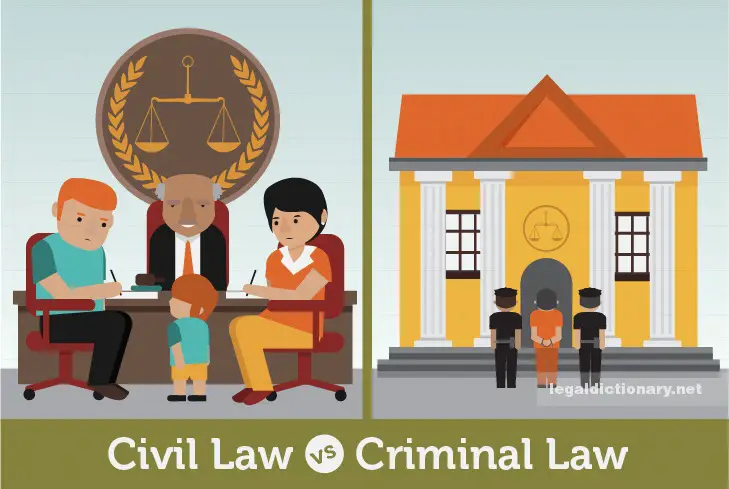
Civil law and criminal law serve different purposes in the United States legal system. The primary purpose of civil law is to resolve disputes and provide compensation for someone injured by someone else’s acts or behavior. The primary purpose of criminal law is to prevent undesirable behavior and punish those who commit an act deemed undesirable by society.
In civil law, it is the injured person who brings the lawsuit. By contrast, in criminal law, it is the government that files charges. The injured person may file a complaint, but it is the government that decides whether criminal charges should be filed. A violation of criminal law is considered a crime against the state or federal government and is a violation of public law rather than private law. Civil law cases are concerned only with private law. In some instances, a person may be entitled to file a complaint, trusting the legal system to punish the wrongdoer with prosecution, while bringing a civil lawsuit to receive compensation for the damages done by the wrongdoer.
Another key difference between civil and criminal law is the standards of proof required to reach a verdict. A plaintiff need only prove his civil law case by a “preponderance of evidence.” This standard requires that the plaintiff convince the court that, based on the evidence presented at trial, it is “more likely than not” that the plaintiff’s allegation is true.
In contrast, the standard of proof is higher in criminal law proceedings. The state must prove their case “beyond a reasonable doubt.” The reason for this higher standard is because a person’s freedom is at stake, and the fundamental belief that convicting an innocent person is worse than allowing a guilty person to go free.
@Asal Ahmed Mohamed
Comments
Post a Comment